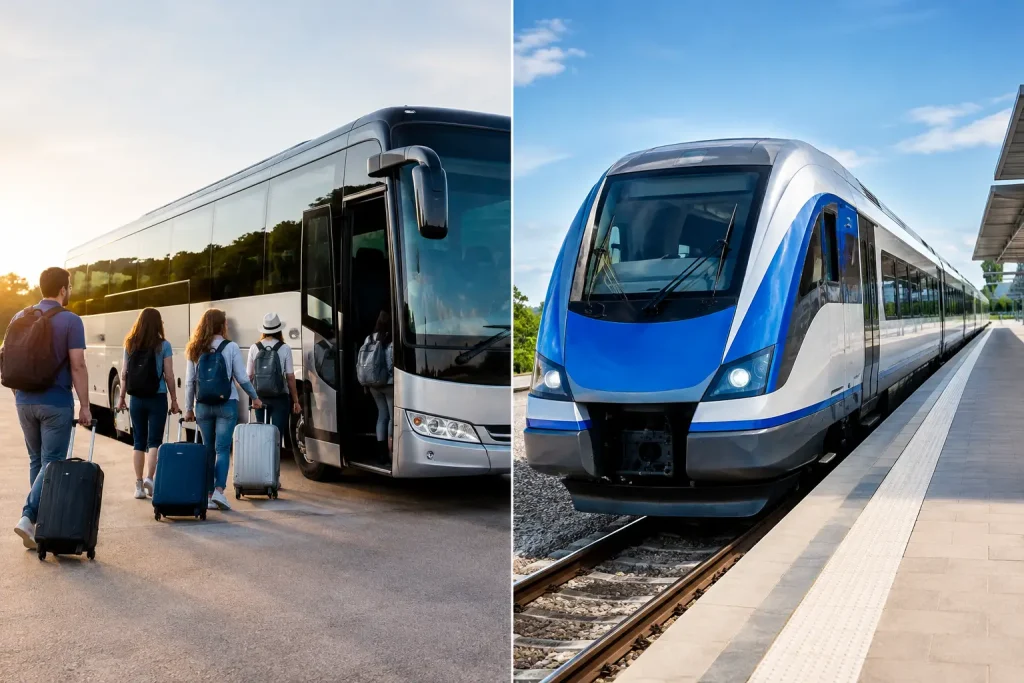
Anyone who has tried to move 20, 40 or 60 people to the same place at the same time knows the real issue is not just transport. It is coordination. That is why coach travel versus train groups is less about personal preference and more about control, comfort and how much complexity your group can tolerate.
For some journeys, rail works well. For others, it creates exactly the kind of fragmented travel day organisers are trying to avoid. The right choice depends on the group, the route, the schedule and the standard of experience you need to deliver.
Coach travel versus train groups – what really changes on the day
On paper, both options can get a group from A to B. In practice, the journey experience is very different.
Train travel usually means working around the rail network rather than around your group. People may depart from different stations, arrive in different carriages and navigate platforms, lifts, footbridges and station exits before the day has even properly started. If there is a change, a delay or a missed connection, the group can quickly split.
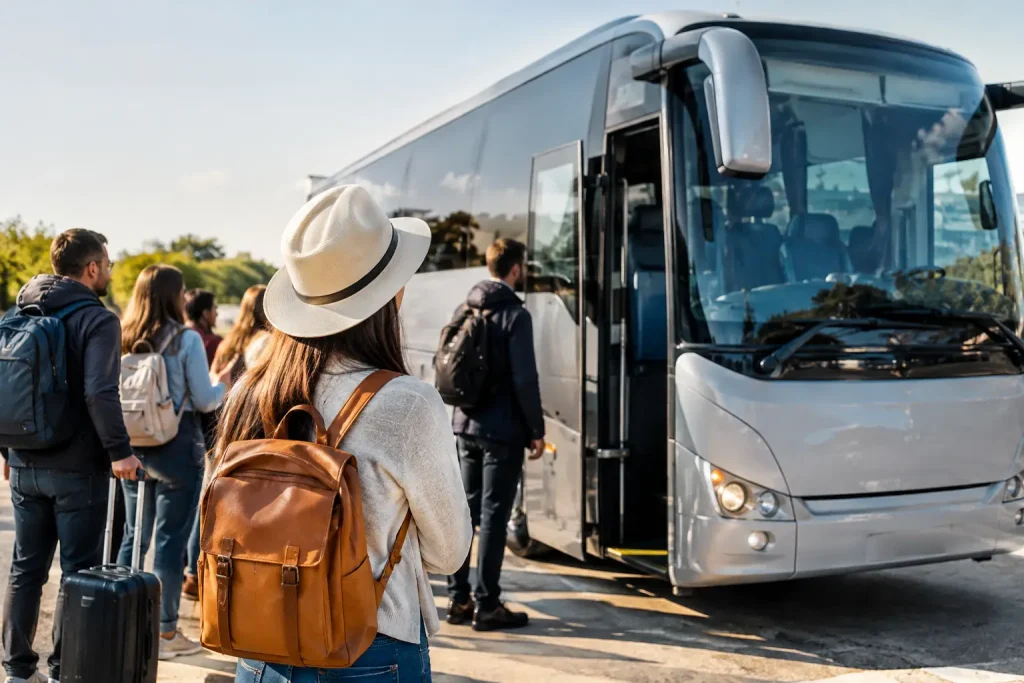
A private coach keeps the group together from departure to arrival. There is one meeting point, one luggage load, one timetable and one transport provider responsible for the journey. For weddings, corporate events, tours and family occasions, that difference is often what makes the day feel organised rather than stressful.
This is especially relevant when your passengers include older guests, children, international visitors or anyone unfamiliar with the route. A smoother process is not a luxury in those cases. It is simply better planning.
Cost is not always as obvious as it looks
Train fares can appear attractive at first glance, particularly if you are comparing advance tickets for a small number of people. Group rail bookings, however, are not always as straightforward as they seem.
Prices can rise sharply depending on the date, time and route. You may also need to factor in taxis to and from stations, parking, luggage handling, seat reservation issues and the cost of passengers travelling in from separate locations. Once those extras are included, rail can become less competitive for medium and large groups.
Coach hire is usually priced as a whole vehicle, which gives organisers a clearer view of the total budget. That makes planning simpler. You know what the group is paying for and you are not constantly managing separate fares, refunds or late changes.
For school groups, wedding parties, sports teams or corporate teams heading to a conference, that predictability matters. A fixed, managed transport solution is often easier to justify than dozens of individual bookings with moving parts.
Comfort depends on the type of journey
Comfort means different things on different trips. If the route is a fast intercity line with a direct service, rail can be pleasant for small groups, particularly when travellers are carrying light luggage and heading into a city centre.
But many group journeys are not that simple. They involve rural venues, hotels outside town, exhibition centres, tourist stops or event spaces with no convenient station nearby. In those situations, the train only covers part of the journey. The rest still has to be arranged.
A quality coach gives groups a consistent environment throughout the trip. Everyone boards together, stores luggage once and settles into the journey without repeated transitions. For longer distances, that continuity is often more relaxing than navigating crowded stations and changing services.
There is also the atmosphere to consider. A private coach gives your group its own space. Colleagues can prepare for a meeting, guests can chat before a wedding, and families can travel together without being scattered across public carriages. The journey feels part of the occasion rather than an obstacle before it.
Timing and flexibility often decide the winner
This is where coaches tend to pull ahead for organised groups.
Train services run to network timetables. If your event starts early, ends late or sits outside a main rail corridor, you have limited room to adapt. You may need to build the entire day around available services rather than what suits your itinerary.
A private coach works to your schedule. You choose the departure point, the pickup times, the stops and the destination access. If the group needs collecting from multiple locations across Birmingham, Coventry or the wider West Midlands before heading to one venue, that can be arranged in a way rail simply cannot match.
That flexibility is particularly useful for weddings, hospitality events, educational visits and tours. If guests need returning after the reception, if delegates must arrive together for registration, or if your group wants a stop on the way home, the journey can be shaped around the day rather than squeezed into a public timetable.
There is a simple question worth asking here: do you want transport that serves the itinerary, or an itinerary forced to serve the transport?
Reliability is not just about delays
It would be too simplistic to say coaches are always more reliable than trains, or the other way round. Road traffic happens. Rail disruption happens. Both modes can face delays.
The more useful question is what happens when something changes.
With train travel, disruption can affect multiple services at once, and your group may receive updates at different times while travelling in different places. Rebooking can be awkward, station staff may be dealing with hundreds of passengers, and keeping everyone informed becomes another job for the organiser.
With a professionally managed coach service, communication is far more direct. There is one vehicle, one driver team, one planned route and one point of contact. If conditions on the road change, the response is coordinated around your group. That creates reassurance, especially when the day has fixed timings.
For premium travel, reliability is also about presentation. Clean interiors, punctual arrival, courteous drivers and a well-run boarding process all shape how the journey feels. A group does not remember only whether it arrived. It remembers whether the experience felt calm and well handled.
When trains make sense for groups
Rail is not the wrong choice in every case. It can suit groups travelling light between major city centres on direct routes, especially when the group is smaller and the timetable is forgiving.
If passengers are joining from different parts of the country and meeting in London, Manchester or Birmingham city centre, train travel may be the most practical shared option. It can also be useful when parking restrictions, central congestion or ultra-short urban hops make coach access less convenient.
There are also occasions where a mixed approach works best. A group might travel by train into a major city and use a private coach for local transfers, event shuttles or onward touring. For some itineraries, that combination offers the best balance of speed and structure.
The point is not that one mode is always superior. It is that group travel works best when the transport matches the real shape of the day.
When a coach is the stronger choice
For most private group journeys, coaches come into their own when simplicity matters.
They are particularly well suited to wedding guest transport, airport transfers, race days, tours, corporate events, school trips and family celebrations. These are occasions where the organiser wants people to arrive together, on time and without unnecessary complications.
They are also the stronger choice when your destination is not station-friendly. Country houses, hotels, visitor attractions, stadiums and event venues often sit well beyond an easy walk from rail. Once feeder taxis or additional transfers are needed, the convenience of the train starts to fade.
For organisers who want the journey to reflect the event standard, a premium coach service changes expectations as well. It creates a more polished start and finish to the day. That is one reason businesses and private clients alike increasingly see quality coach hire as part of the experience rather than just the logistics.
Making the right call for your group
If you are weighing coach travel versus train groups, start with four practical points: how many people are travelling, how fixed the schedule is, where the destination sits in relation to the station network, and what standard of experience your group expects.
If the trip is simple, city-centre based and direct, rail may do the job well. If the day involves luggage, multiple pickups, timed arrivals, rural venues or guests who need a smoother experience, a coach will usually offer greater control.
That is why many experienced organisers choose private group transport for the moments that matter most. It reduces friction, keeps people together and gives the day a stronger sense of order from the first pickup to the final drop-off.
For groups travelling across the West Midlands and beyond, that peace of mind is often what turns a journey from a logistical exercise into something that feels properly looked after. And when people remember the day, that is exactly how travel should feel.