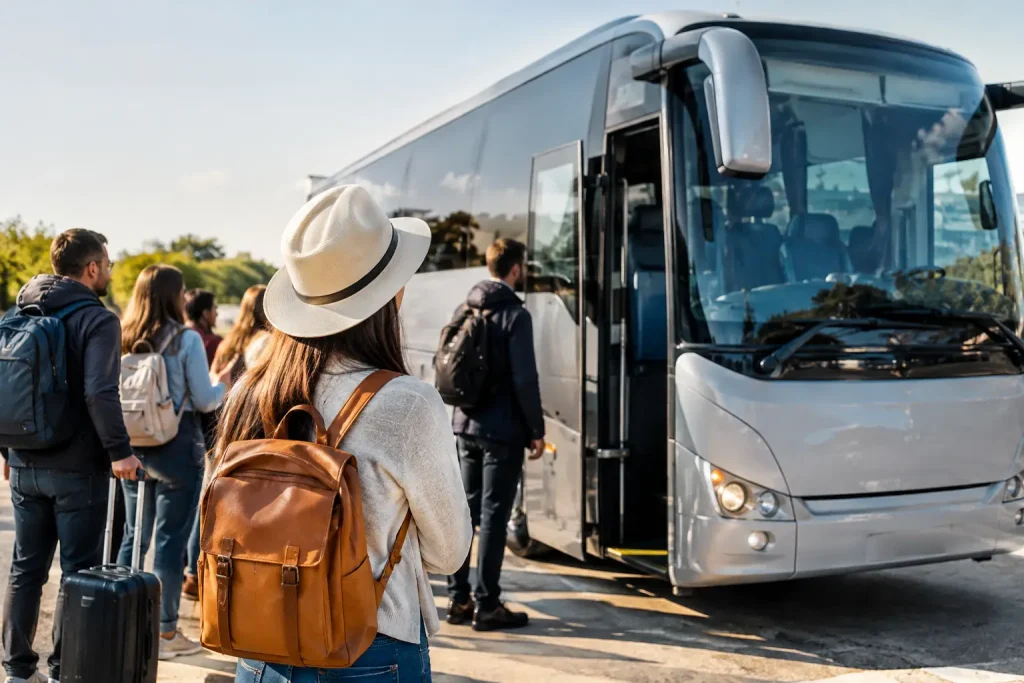
A coach full of colleagues heading for a conference in Paris, a wedding party travelling to the Algarve, or a family group beginning a European holiday has one question to settle before any hotel is booked: can coaches travel across Europe? Yes, they can. A well-planned private coach journey remains one of the most comfortable and sociable ways for a group to travel from the UK into mainland Europe.
The important qualification is that European coach travel is not simply a longer domestic hire. It involves border formalities, driver working-time rules, country-specific road requirements and a route that gives passengers time to enjoy the journey. With an experienced operator managing those details, a group can travel in comfort while keeping the itinerary organised and realistic.
Can coaches travel across Europe from the UK?
Yes. UK-registered coaches can carry private groups from the UK to European destinations, usually via the Channel Tunnel or a ferry crossing. The right option depends on where the journey begins, the destination, the group’s timetable and the type of experience required.
The Channel Tunnel can be particularly efficient for groups departing from the West Midlands for northern France, Belgium, the Netherlands and beyond. Ferries may make more sense for certain coastal routes or when an overnight sailing helps the group arrive rested and ready for the next stage. Neither is automatically better. The best choice is the one that fits the overall itinerary, including driving distances before and after the crossing.
For a private hire, the operator will need to ensure that the service is authorised for the countries and journey type involved. Requirements can differ depending on whether the trip is an occasional private tour, a regular passenger service or includes domestic pick-ups within another country. This is one reason to use a specialist coach provider rather than treating an international trip as a standard local transfer.
The paperwork behind a smooth crossing
A polished journey starts well before passengers step onto the coach. Every traveller needs a valid passport, and travellers who are not British or Irish citizens may need to check visa requirements for each country on the itinerary. Passport validity rules also matter, particularly for travel into the Schengen Area.
For many UK visitors, time spent in most European countries counts towards the Schengen 90-days-in-any-180-days allowance. That may have little effect on a weekend break, but it is worth checking for guests who travel frequently for work, own a second home abroad or are joining an extended tour.
The coach operator must carry appropriate vehicle, insurance and international transport documentation. Drivers also need the correct professional qualifications and documents for the countries being visited. Requirements can change, so a responsible operator checks the current position rather than relying on paperwork used for a previous trip.
Groups can make border checks easier by providing passenger information accurately and early. Names should match passports exactly. If children are travelling without both parents or legal guardians, families should also check whether consent documentation is recommended or required for their circumstances. A few careful checks before departure can prevent an avoidable delay at the port or terminal.
Driver hours shape the itinerary
The most overlooked part of European coach travel is the driver’s legal rest requirement. A professional driver cannot simply continue until the group reaches its hotel. Rules on driving time, breaks and daily rest are designed to protect passengers, drivers and other road users, and they must be built into every credible itinerary.
That affects more than the number of kilometres on a map. It influences departure time, the choice of crossing, meal stops, overnight locations and whether a second driver is needed. A direct drive from Birmingham to a city in central Europe may look possible online, but a realistic plan must include border time, traffic, comfort stops and the driver’s lawful rest.
For short European breaks, one driver may be suitable if the destination and schedule allow for sensible overnight stops. For longer distances, late arrivals, touring programmes or time-sensitive events, a relief driver can be the better choice. It adds cost, but it can also protect the guest experience by allowing the itinerary to move efficiently without putting pressure on anyone behind the wheel.
A premium journey should never feel hurried. Time for coffee, meals, fresh air and hotel check-ins is part of the service, not an inconvenience to be removed from the schedule.
Choosing a route that suits the group
Europe offers extraordinary variety within reachable coach distance, from the historic streets of Bruges and Amsterdam to the vineyards of Champagne, the lakes of northern Italy and the alpine scenery of Switzerland. The right route depends on the purpose of the trip as much as the destination.
A corporate group may prioritise a punctual arrival, quiet onboard time and hotels close to a conference venue. A school, family or leisure group may prefer regular stops, sightseeing on the way and an itinerary that avoids excessively long travel days. Wedding guests may value a single coordinated departure and the reassurance that everyone arrives together.
Route planning also needs to account for local restrictions. Many European cities operate low-emission zones, restricted-access areas or permit systems. Coaches can face different rules from private cars, especially near historic centres. A professional operator will assess where the coach can set down passengers, where it can park and whether a hotel or venue has practical access for a larger vehicle.
This level of planning matters in cities such as Paris, Brussels, Amsterdam and Florence, where the final few miles can be more complicated than the motorway journey itself. The ideal solution may be a central set-down point followed by a short walk, or a carefully timed arrival outside the busiest period.
Comfort matters on continental journeys
Travelling together by coach turns the journey into part of the occasion. Rather than splitting a group across flights, hire cars and rail connections, passengers can settle in, talk, rest and arrive as one party. It is particularly valuable when luggage, event equipment or multiple generations are involved.
Vehicle choice should reflect the group, not just the passenger count. A compact executive minibus can suit a small corporate delegation, while a full-size luxury coach gives larger groups more room to relax over longer distances. Luggage capacity deserves careful attention too. Ski equipment, wedding outfits, golf bags and touring cases can change what is practical, even when there are enough passenger seats.
Cleanliness, comfortable seating, climate control and a courteous driver make a genuine difference when several hours are spent on the road. For long-distance travel, those details are not indulgences. They help passengers arrive composed, rather than tired from the journey.
Budgeting for a European coach hire
International coach hire is priced around the complete operation, not solely the mileage. The quotation may reflect vehicle size, the number of travel days, driver accommodation, toll roads, ferries or Channel Tunnel crossings, parking, local permits and any requirement for additional drivers.
The lowest initial figure is not always the best value. An unrealistically tight route can create costly disruption later, while a clear itinerary and properly allowed driver rest can reduce the risk of missed reservations or a last-minute change of plan. Ask what is included, how waiting time is handled and whether expected overseas charges have been considered.
It is also wise to share the full itinerary from the outset. Include venue addresses, hotel details, passenger numbers, luggage expectations and any fixed appointments such as a ceremony, cruise embarkation or corporate meeting. The more complete the information, the more confidently the journey can be planned.
Booking with confidence
European group travel rewards preparation. Ideally, start discussing the trip several months ahead, particularly for peak summer dates, Christmas markets, major sporting events and popular wedding weekends. Early planning provides more choice around vehicle availability, crossings and driver schedules.
Before confirming, make sure the proposed plan answers practical questions: where will the coach collect the group, how long is each travel day, when are breaks planned, what happens if a border crossing is delayed, and how will the driver’s overnight arrangements be managed? Clear answers are a strong sign that the service has been planned professionally.
For groups departing from the West Midlands, Zen Travels can provide the calm, considered approach that international travel deserves, combining luxury coach or minibus hire with practical journey management. The aim is simple: passengers should feel looked after from collection to arrival.
The most memorable European trips are rarely the ones that chase every last mile. Give the route enough time, choose a vehicle that makes the distance comfortable, and let the journey begin well before the destination comes into view.